Showing posts with label Mountain flying. Show all posts

Wednesday, March 6, 2013

Blast From the Past Part 3

When we last left our intrepid hero, he was hurling straight at the side of a mountain at 80 knots. Will he be able to turn away in time? Will he puke all over the windshield, or just wet his pants?? We are about to find out in the third installment of the MAF Technical Evaluation. This was one of the last-first steps to becoming a missionary with MAF. Enjoy!

The natural tendency is to pull back on the yoke, but this is discouraged (trust me, it is TOUGH to ignore the feeling in your gut SCREAMING at you to pull back). We got roughly as close as 1/4 of a mile from the mountain and turned away. With a horizon full of mountain in every direction, it’s very difficult to tell if the airplane is climbing or descending. I know it sounds simple, but it is really a difficult thing to do. We in fact did that a few times, then actually flew up a canyon, and then performed a ridge crossing. The mountains in this area are absolutely stunning and rugged. After this we went to another airport to practice short field landings and takeoffs, using the MAF checklist system. These went pretty well. Scott demonstrated a few for me and I was able to duplicate the same procedures and get the airplane off the ground and back on the ground in about the same distance as him. Then we went back to Nampa and were done flying for the day. He briefed me on the cross country he wanted me to plan and we were done.
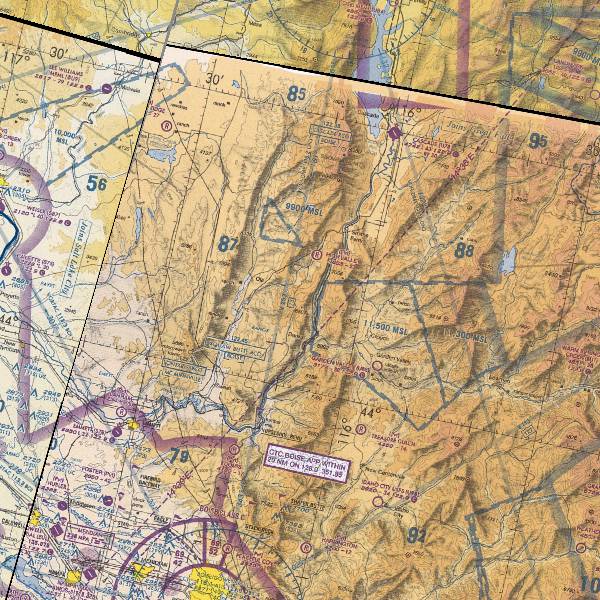


Thursday I got to the airport, with the flight plan in hand, and we departed. Again, the beauty and ruggedness of the area are so hard to comprehend, even looking at it. We flew north to McCall, did a landing, then instead of flying directly to another airport west of there, he gave me an altitude not to go above, which required me pick my way through valleys and canyons and other terrain. This airport was 1800 feet above sea level, in an area where most of the terrain was around 5800 feet. So needless to say, it was Ray Walker’s voice deep down in a huge canyon, at the very bottom right next to a beautiful river. This airport was closed so we just did an approach and then instead of landing, climbed out of the canyon and went to our next airport. We landed there and ate lunch. He then gave me 10 minutes to plan the remainder of the flight which was to another airport then back to Nampa. After we took off, he "failed" the engine on me. I found an airport, mentally planned the gliding approach, and landed safely.

 We took back off, and he simulated an emergency medical call to an “airport” not even on the map. He had to draw the “airport” on the map, and I had to find the headings and distance, and then navigate to it. After the time it should have taken to find the “airport” elapsed, I couldn't find it. I was sure I had failed the flight evaluation. We searched around a little and didn't see it. So went back to my last known point on the map and tried it again. This time I found it....remarkably. The “airport” was nothing more than a clearing of tumbleweed on the side of a mountain and a windsock. Then he had me go back to Nampa. All the flying we did that day was without any GPS or other navigation equipment. All I could use was a compass, map and clock.

            Normally, in flying or leisure or for corporate, we just wear a headset and maybe sunglasses if needed. These weigh next to nothing and pose no strain on a neck. During the flight portion of the Technical Evaluation, we wore helmets which had a sun visor built in, and a headset, much like what the military fighter pilots wear.


      They are pretty neat looking and surprisingly light. However, with my nerves, and having to look at a map in my lap every few minutes, then out the window straining to find land marks, then back to the instrument panel, then to the instructor, then back to the map in my lap, the weight of my helmet took its toll on my neck. Once the adrenaline of the day wore off as I walked back to our apartment, my neck just about completely locked up. 

(Editors note: Thanks to Hosenfeld Chiropractic in Knoxville, TN the neck issue should be no problem now. They put in a lot of time and effort in aligning everything and giving me exercises to strengthen it and keeping it in check, plus much needed support and encouragement in the fundraising process. Thank you so much for your help! My neck loves you for it!)

Stay tuned for the last in the series next week.


Wednesday, February 27, 2013

Blast From the Past Part 2

     When we posted the last blog re-reporting on our experience at the Mission Aviation Fellowship Technical Evaluation, I thought the next email I wrote was shorter… I was wrong. It was about 3 times the length. So this will be the second of at least two more posts. It has been fun reading what we wrote several years ago, remembering the emotions, the excitement, the anticipation and the NERVES!! For the flight portion especially. Hope you enjoy!

          We have been back in East Tennessee for a week now, trying to get caught up at home, work and on our sleep. Continuing where we left off, we had our psychological evaluation on Monday, May 2. We got to the Docs office around 10:30 in Boise, which was about a twenty-five minute drive from the MAF campus. They had us take a test, the MMPI-2, which stands for Minnesota Multiphasic Personality Inventory. It was kind of a goofy test, asking if we wanted to be florists, if we were possessed by demons, or if we liked to tease pets (I had to answer yes on at least one of those, can you guess which?). It was 567 true or false questions and it took about an hour and a half to take. Once we finished, we had a two hour break and drove around for 30 minutes trying to find a suitable place to eat. This baby that Tasha is growing for us sure is picky. We finally found a pizza joint and took our time eating.

 Once we got back to the office, Dr. Bennet took me back first. He asked mainly about how we met, how long we had dated, how long we have been together, how I proposed, and other stuff like that. We really didn't get into the results of the test too much, but he did pick up on my personality really quickly. He diagnosed me as a “nose to the grindstone, gotta work quick, gotta work hard, gotta work now” kinda guy. He also knew how my work ethic coupled with my ADD past could cause problems and just cautioned me to pay attention to what my family was going through with the whole process of all the training, fundraising and travel overseas.

(Editors note: Boy was he not kidding…. Click here to read about a perfect example of this….)

           He then took Tasha back and talked with her for about 35 minutes asking about her past, how she felt about the whole idea of serving the Lord through MAF overseas, etc. The experience was actually much better and nurturing than we were expecting. We had heard some stories from some of the other families that made us a little leery, but we cannot complain.
 
 Tuesday began the flight portion. Tasha was still nauseous most of the time, and because of a cold, was still coughing and feeling downright icky. The flight instructor and I did the pre-flight on the airplane, hopped in, and took off.  We flew west about 20 miles, well clear of the city and Boise airspace. We did turns, steep turns, slow flight, stalls, turning stalls, followed by some other maneuvers that I had never practiced before. They asked me to slow the airplane down to 80 knots with the wing flaps up. Then, I was to drop in full flaps, keep the airspeed at 80 knots, maintain altitude and heading, and then bring the flaps back up, while keeping everything else the same.This was an exercise to help understand the correlation between drag, lift and power (I think....). Then we went to an airport north west of Nampa to do some touch and goes.

 The first landing was not as good as I expected. Not to mention my landing pattern, a rectangular shape flown around the runway, was very much askew because I am used to flying much faster aircraft and was used to making turns much sooner than required of the Cessna 206. In the Beechcraft Baron, we normally fly the pattern anywhere from 120 to 150 knots, in the 206 however, we were doing it at 55 to 70 knots. Because of the extra airspeed, the Baron has a much more "positive" feel with less input into the controls. The 206 just as a different feel and it took me a while to get used to it. By the end of the first day though, my landings became smoother, I got used to the height of and attitude of the airplane on the ground. I wasn’t feeling too confident though. I thought my maneuvers were sloppy. They gave me some tolerances, + or - 10 knots on the airspeed, + or - 100 feet on the altitude and + or - 10 degrees on the heading. I was within those, but I felt I could have done much better. I also know the caliber of Pilots MAF looks for and didn’t feel like I met their expectations. I was done by 1 or 2 just about every day of the flight week, which gave me more time to go study and spend time with Tasha.
 
      The second day was more instruction than evaluation. My instructor introduced some mountain flying concepts to me, how to determine if we could safely fly up a narrow valley/canyon, and how to cross a ridge line safely with only 100 feet between the landing gear and the top of the ridge. First we practiced the maneuvers at 5500 feet, away from any terrain. The procedure was to slow the airplane to 80 knots, and 20 degrees of flaps, and complete the landing checklist.

      MAF is all about the use of checklists. This is a GREAT thing, and one of the things that most pilots (myself included) get complacent on. MAF understands it can be a pain, so they make it easy. The printed the checklist on one sheet of paper, so no more searching to find the right page, and also permanently fixed it to the yoke, so its right in front of you. For landing and takeoff, they also made a series of switches, each with a certain task required to be completed before the switch was flipped. When all 5 or 6 switches are flipped, a green light turns on indicating the airplane is configured for either takeoff or landing. Anyway, back to terrain flying.

      When the airplane is setup in the 80 knots and 20 degrees of flaps, a 45 degree bank turn is entered, add a little bit of power and back pressure on the yoke, and the turn radius (or horizontal distance covered on the ground) is radically reduced without loosing any airspeed or altitude, which provides a safe way out in case a canyon turns into a dead end. It sounds easy at altitude and away from terrain, and it is because you can see the horizon quite well and you can understand the relation of the airplane to the horizon. But then we descended down to 3500 feet, and pointed the nose straight at a mountain. We set the airplane up in the terrain configuration and waited.....and waited.... and waited... the mountain kept getting bigger....... and bigger.... and closer......and bigger…… To be continued…