Wednesday, January 29, 2014

Rich Blessings


Another lovely MAF wife made the statement about having shock over the level of poverty seen around them, but her shock came from the realization that she was wealthy. And with her realization came the reality that she has always been wealthy and never realized it.

Did you know I was richly blessed? I don’t mean I am sitting on a nest egg ready to retire or that I own gold tucked away in Fort Knox. And in this context I’m not referring to the number of our wonderful friends and supporters we have blessing us beyond measure. No, I mean I am wealthy and so are you. Don’t believe me?
  • I have never had to go outside with a spoon to eat dirt in an attempt to take away the hunger pains. I know what it feels like to be full, even too full.
  • I have access to enough water to bathe/wash on a frequent basis.
  • We own more than one set of clothing, and are able to clean them.
  • My baby owns at least one toy.
  • I have never had to send my child to bed hungry.
  • I own shoes.
  • Not only do we have plumbing, we have the ability to filter our water and not worry about getting sick from it.
  • I had the luxury of being able to afford to attend and complete (primary) school.
  • I own a bed.
  • I have never watched my child laying sick in a hospital bed while the doctors refuse to treat them until more money comes first.

We have been in Congo for just over three months now; some of the honeymoon period is starting to wear off, and some of the realities and struggles are starting to set in. As we are trying to learn various things to which we can cling to keep us motivated, we have reflected on these things. But sometimes this list is actually discouraging. It’s tough to be inside a house (with a roof) knowing that some people walking down the street outside have to deal with not having some or any of these "blessings".  But take a look at Matthew 5 and what Jesus said:

"…and He began to teach them. 'Blessed are the poor in spirit, for theirs is the kingdom of heaven. Blessed are those who mourn, for they will be comforted. Blessed are the meek, for they will inherit the earth. Blessed are those who hunger and thirst for righteousness, for they will be filled. Blessed are the merciful, for they will be shown mercy. Blessed are the pure in heart, for they will see God. Blessed are the peacemakers, for they will be called children of God. Blessed are those who are persecuted because of righteousness, for theirs is the kingdom of heaven. Blessed are you when people insult you, persecute you and falsely say all kinds of evil against you because of me. Rejoice and be glad, because great is your reward in heaven...'"

In French, and in some English translations, it even says, “happy are those…” In my minds eye, I think of the faces of Congolese Christians I know. I smile when I read these verses, because I know for them there is hope. Their blessings do not rest in material things, or things to make their lives easier. Their hope, many times their only hope, is embedded in these promises of Christ. At first, I must admit, it stung when I thought of it this way. But the more I think about it, they too are blessed. Richly blessed. Lord, reveal yourself to the Congolese who don't know you, so they can learn how great of a reward and  true blessing is found in your love, grace, and righteousness.

Thursday, January 2, 2014

....Ndolo Tower.....Say Again???

As I completed the final items on the before takeoff checklist and prepared to call the flight follower in Vanga, I heard Ndolo Tower come on the radio with a very strong accent. Her voice gave almost no distinction from one word to the next.

"Nine Mike Echo, taxi back runway eight, ATC clearance as follows, clear to Vanga via Ulvas, after departure maintain runway heading, climb two-zero-zero-zero, right turn, pass over Kilo Sierra Alpha three-five-zero-zero minimum, climbing zero-five-zero, intercept zero-four-six degree radial, report passing two-zero-zero-zero right turn, next call ready for departure"

Huh?

I heard my call sign "Nine Mike Echo," and fortunately I had written down the basic pattern they use and made out enough numbers that I could fill in the blanks.

I repeated the clearance, "Nine Mike Echo, back taxi runway eight, cleared to Vanga via Ulvas, runway heading after departure, climb two thousand feet right turn, pass over Kilo Sierra Alpha three thousand five hundred feet, intercept zero-four-six degree radial, climb to and maintain five thousand feet. Will report passing through two thousand feet right turn, next call ready for departure."

Hey, that sounded good! Then, there was a long pause...I could almost hear her thoughts, almost word for word: Huh? (Except in French, "l'huh.")

She came back on, and repeated her clearance, inferring she did not understand me. This time her transmission was broken, but I was still able to pick out the pieces. The rule of primacy was becoming a problem from all of my time spent in the American Air Traffic Control System. All of the flows, speech patterns and phraseology that I would use stateside, I must forget...or at least shove in the back corner of the hangar in my brain.

I wondered, what could I do differently to help her understand, that I understand the instructions. Oh Yeah! I have to repeat it exactly. I can't say two thousand, or three thousand five hundred. I can't say things in the order I'm used to, I have to repeat it back exactly as I heard it.

Quite frequently, the actual flying-the climbing, turning, descending, and landing- this is the easy part of what we do. It's all the other stuff to get us in the air that proves to be the challenge.

Finally, we were on the same page. A quick check of the time, passengers, hand brake and wind, add the power, a touch of right rudder, and we are airborne, on the way to Vanga to deliver 120 kilos of cargo and two of our national Internet Tech staff to install a new VSAT internet satellite system for a ministry in the middle of the African bush. I love my job.

Sunday, December 29, 2013

And The Winner Is.....

Okay, it's a little after the 26th, but we do have a winner to our Caption This contest. We have also decided to add prizes for second and third place as well.

The Third Place Award is a 500 Congolese Franc bill.
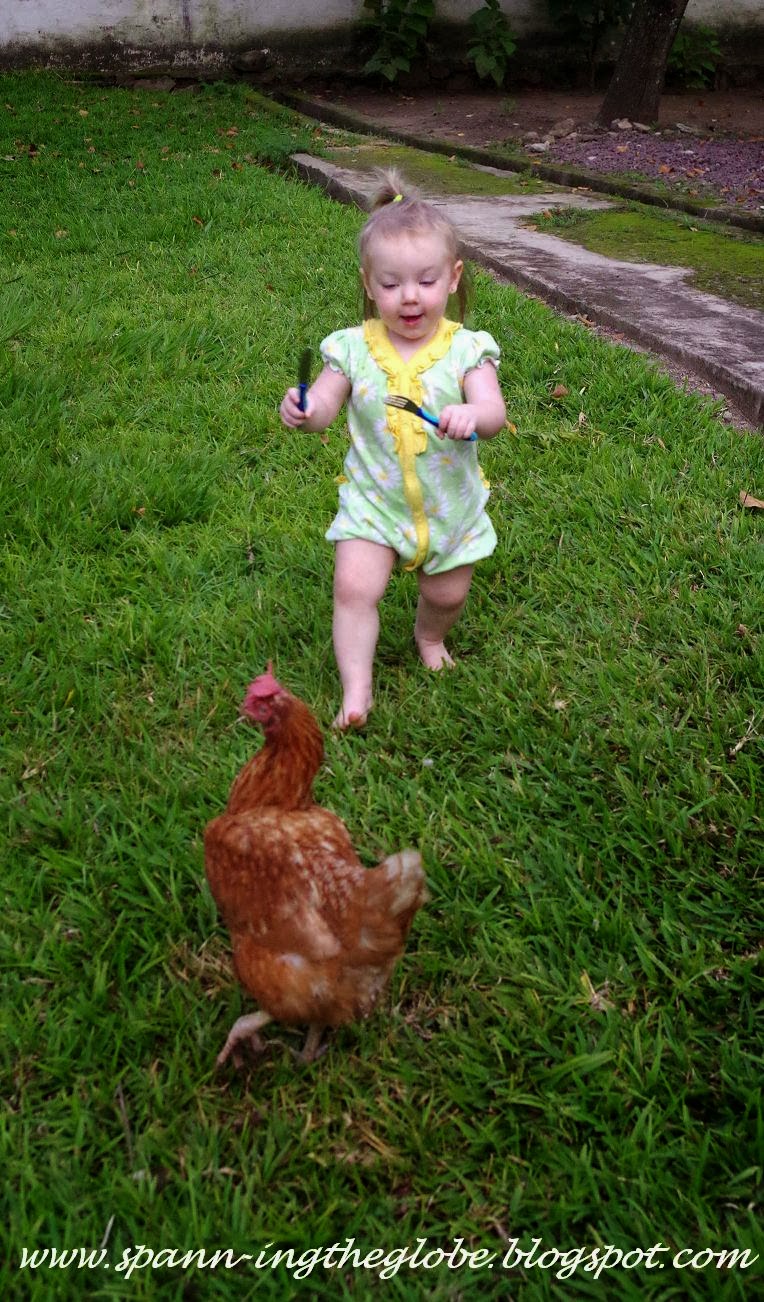
The award goes to the post from Facebook, "Who is chasing who NOW chicken?!"

The Second place Award, is a 500, a 200, and a 50 Congolese Franc Bill.
The award goes to the post from Facebook, "Yummy payback for stealing my muffin !!!!" 

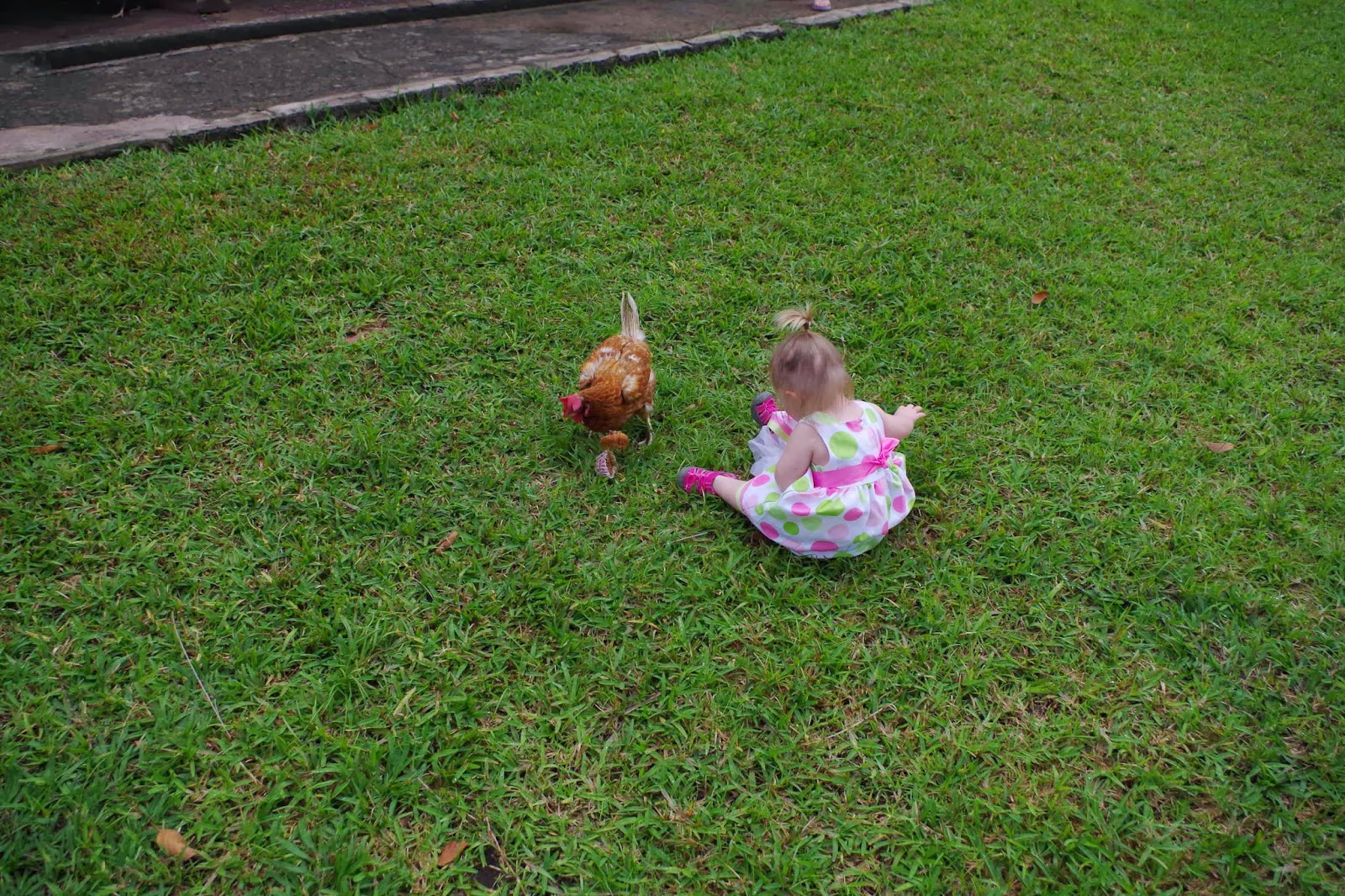
I should say there is a back story for the second place (and also relevant to third place). But since the original post was in pictures, I will let them speak for themselves:


Although, in the context of these photo's, the second place comment is probably more appropriately, vengefully funny, the competition was for the best stand alone comment...It's there in the fine print somewhere...

See, doesn't that story just melt your heart?

Anyway...And the First Place Award is a 500, a 200, two 100s, and two 50 Congolese Franc Bills.

*Before anyone gets too excited, this is the equivalent of about $1.25.

I should also remind everyone that we were completely unbiased, and awarded points based on the number of laughs whenever we came back and re-read all the entries.

The First Place Award of 1,000 Congolese Francs goes to the Facebook Post "The African version of duck, duck, goose is INTENSE! Should call it cluck...cluck...cluck...FOOD!!!"

Congratulations to all, and please allow several weeks for delivery. Thank you so much participating, and reading our stuff. It makes us feel good to see everyone who participates. Until next time, Bonne Anné!


Friday, December 20, 2013

Caption This!

Kevin and I adore games, so we have decided to play "Caption This!" Below you will find a photo that has not been edited but is from our "normal" everyday lives. Please type in your best caption in the comment section. We will chose the best caption and the lucky winner will receive 1000 Fc (Congolese)*! Contest will conclude at midnight EST on December 26th, 2013 and the winner will be announced shortly thereafter.

*Please allow a few weeks for delivery.
**Winner will be chosen by an unbiased panel of judges (us).


Tuesday, December 17, 2013

A Day of Dilemmas

Today was one big example of how sometimes you just have to sit back and go with the flow.
Dilemma #1: Miss Priss woke up at 6:40.
Solution:  Encourage baby to snuggle longer in bed with mama using the iPad as a bribe.

Dilemma #2: Power went out early in morning and lunch time is approaching.
Solution: Remove semi-frozen chicken and cook on propane burner, toss in veggies, mix up some homemade biscuit dough, and voila! Chicken and dumplings cooked on one burner.

Dilemma #3: During deboning of chicken, baby girl decides to open the mini fridge and remove a glass Coke bottle, thus shattering it on the floor.


Solution: Grab baby and place her in the sink, immediately scrub chicken off me and blood and glass off baby.*

(*Side note to any grandparents reading this – baby just got a little scratch on the tops of each foot…which bled more than was necessary.)

Dilemma #4: Messy kitchen and bloody baby at nap time.
Solution: Ask Papa Didier for help to clean up kitchen while I apply band-aids to squirmy baby.

Dilemma #5: Papa Didier has a headache and explains he will need to go to the doctor after work to get medicine.
Solution: Provide Papa Didier with 2 Tylenol for now and a lukewarm Coke (since power is off) as a bit of caffeine to help.  I also gave him 2 additional Tylenol in a baggie for later with instructions not to take for another 4-6 hours if he still has a headache. (I totally saved him $15! I feel like could be a nurse now…just joking.)

Dilemma #6: Papa Didier informs me that the spotted bunny gave birth successfully to 11 babies, but one died this morning getting caught in the wire of the cage.
Solution: After a stunned silence (I had no clue the bunny was even pregnant as the females and males were in completely different cages), I politely thanked Papa Didier for tending to the dead bunny. Then, I take the cardboard box I had been saving for our next move and make a baby bunny nest. I even filled it with fresh grass.

Dilemma #7: While transferring babies to new bed, I notice another bunny has “ceased to be.”
Solution: Ask Papa Didier to take care of it (I am too short to reach).

Dilemma #8: Notice that the female bunny in the next cage is eyeing the newborn bunnies.
Solution: Ask Papa Didier’s advice about possibly moving the bunny to a new cage to prevent any fighting. Papa Didier informed me that she is too tired to fight. She will give birth in a day or two. (again, see #6!)

Dilemma #9: The possibility of a second batch of bunnies when I was shocked about the first.
Solution: Take the second coveted cardboard box I had been saving for our move and make a second nesting box.

Dilemma #10: Running late to band rehearsal.
Solution: Nothing. Eat lunch slowly. Drive normal speed. Show up 30 minutes late and find everyone else running behind as well. We didn’t start for another 30 minutes.

Dilemma #11: Getting to drive home in Kinshasa traffic for the second time.
Solution: Joke the whole way about cars honking at me because I don’t pull out into traffic immediately and stalled only once (please see rule #1 about driving in Kinshasa)!

Dilemma #12: Overtired, hot baby at bedtime.

Solution: Strip her down to her diaper, nurse and rock her, and put her to bed.

Dilemma #13: Still no electricity and it’s dinner time.
Solution: Let Kevin go to grocery store to pick up some meat to cook. Then, I sit back and watch him work his magic and enjoy dinner made on a propane burner!


All day long, little problems came my way. I could have sat down and cried and allowed any one of those things to defeat me, especially when they started piling up all at once. But I chose not to do that and instead, I went with the flow. I think I had a great day! Extra snuggles with my girl, delicious food, 9 baby bunnies, excellent dress rehearsal at play, a chance to practice driving, and a chance to practice my French! I had a great day, how about you?

Sunday, December 8, 2013

The 10 Commandments of Driving in Kinshasa


1. Don’t hesitate…EVER: when you are dealing with thousands hundreds of thousands of cars (see #7), all of the traffic is stop and go. If you want to go, you have to take every open spot. In the states, we call that “cutting someone off.” Here, it is called driving.  Following distance here is also very important. In the states, they recommend to have at least a 3 second gap in between you and the car in front of you. Here, the gap is more like 2 to 3 inches. There are so many cars that there is never a guaranteed opening or a guaranteed person to stop and let you out. You must take advantage of every open space. You will see other drivers using the sidewalk, driving in the “wrong direction”, or even people driving cross ways. Your best bet, don’t hesitate!

2. Pull over for sirens: If you hear a siren, you move your car over as far to the side as possible, but these sirens aren’t for what you might think. The siren is a warning that they are escorting someone important and you must move out of their way. What will follow could possibly be a military convoy, the president, a high ranking UN official, etc.

3. Don’t stop for car accidents: in the States when there is an accident, the police are called to the scene. Here, it is a truck full of military men. Of course they mostly surround the vehicles to protect the people involved, but they still have a protocol. What is not required is your assistance unless you are a qualified trained medical professional who can aid. Other than that, you will not only be in the way and/or someone might mistake you for the perpetrator. For accidents, no scenes are recreated, no interviews are taken, and no tickets are issued (but a fine could be involved). What is important is the safety of each person involved and getting the traffic to flow again, and a white person would just be a distraction and in the way.

4. Use lights sparingly if at all: headlights are only to be used well after dusk. If you put your lights on too early, the police will ticket you. Only important officials are permitted to have their lights on during the day to let the police know they get to bypass all traffic (see #2)

5. Use your horn: horns are important here. In the states, you only use them to warn people or if you are really rude. Here, they are a necessity. You honk to let someone know you are going to pass them.  You honk to let someone know they can pass you. You honk to let someone know not to pull in front of you in traffic. You honk to let someone know they can pull in front of you in traffic. You honk to let someone know you are going to pull over to let more people in your car. You honk to let someone know you cannot stop to let more people into your car. You honk to let someone know it is safe to cross the road in front of you. You honk to let someone know it is not safe to cross the road in front of you. You honk to let someone who is selling things on the side of the road know you are interested. You honk to let someone who is selling things on the side of the road know you are not interested.  You honk to let someone know they are crossing into your traffic. You honk to let someone know you are skipping traffic by taking the sidewalk (no joke).  You honk to let someone know to move out of your way. You honk to let someone know you have space in front of you for one more. See! Horns are important!

6. NEVER splash anyone: as chaotic as life is here, with cars filling any void on the road, there is still a need for respect. But with the state of the roads this one is tough. We have seen potholes the size of a mid-size car, and over a foot deep. You show respect by never splashing someone with water from a puddle small lake. Why is this so offensive? When you go outside of your home, you are expected to dress your best, even if you are walking across the street (it’s amazing how people keep their white shirts so crisp and clean). Thus, everyone walking around is in their best clothing. If you ruin their nice clothing, that is definitely a tragedy! It would be like me spilling red Kool-Aid on a soon-to-be-bride’s dress right before her wedding. So, no matter how much it rained the night before, no matter how hectic traffic is, SLOW DOWN for each puddle  crater and be overly cautious!

7. Forget your personal space: we live in a big city with a stated population of over 10 million people and very few own cars (if only 1 in 20 own a car, that’s still a half a million cars driving around). Thus enters public transportation, but nothing nice like a city bus. Nope. We are talking 15 passenger vans. Vans that have had the seats removed. Vans that now have wooden benches screwed to the floor boards. Vans with roughly 35 already on board, but somehow always room for one more. Vans that keep their doors open to make room for one more jumping on or off, but rarely coming to a complete stop.  Vans with people standing on the bumper, hanging off the back in flip-flops.

8. Lock your doors: locking your doors is done for many reasons. Picture yourself driving down an unknown street in New York. You lock your doors for a security measure. In a place where traffic is always stop and go, it is best to be secure when you might forget what street you are on. You never know if the person trying the door handle is a pickpocket or just someone needing a ride home and notices you have an empty seat (See #7).

9. Stop for the flag: At 6 AM the military will raise the flag of the DRC on all their poles. At 6 PM the military will lower all Kinshasa flags for the night. If you are in the vicinity of the flags, you must stop everything. If you are driving, you stop. If you are crossing the street, you stop. If you are shopping, you stop. It is a little eerie to look around you and see everyone standing completely still, some even mid-stride, almost like the beginning of a scary movie. But at the same time, to know these people have such respect for their nation that they stand motionless and wait for the procession to be over.

10. Tipping is optional: there are always a plethora of people in small parking lots willing to help you pull out into traffic. Usually by standing in the middle of the road to stop cars or make them move out of the way. You don’t have to tip them, but it is still a very nice thing for them to do. (Also note, you don’t tip more than 500 Congolese Francs [roughly 50 cents]).  You can also “tip” them with food donations as well.


*Bonus rule – Motorcycles: motorcycles are a new phenomenon here. They were introduced roughly two years ago as a cheap alternative for those who could not afford cars. That sounds great, right?!? But when traffic is stop and go and you see an opening, HELLO MOTO (see #1)! Motorcycles are used for taxis and often hold three or four people (and sometimes farm animals, groceries, heavy things balanced on peoples’ heads, and everything including a kitchen sink [only wish we had a photo!]). Your best bet is to just be cautious and assume a motorcycle is nearby to cut you off drive around you as you are pulling out into the traffic.  

Wednesday, December 4, 2013

Hypothermia in the Congo

I know, the title is an attention getter right? But it's true. Today, I nearly got hypothermia, here, in the Congo. Let me explain.

Here, it's hot. And humid. Like summer in Florida, hot and humid. Except being on the equator, the sun is more intense.

Also, for safety on the road, we need to keep our windows rolled up at all times. Otherwise people walking by could reach in and take whatever they wanted out of the car. Not good.

Because it's hot, and because we need to keep our windows rolled up, the car's air conditioner needs to work REALLY well. Otherwise, we get heat stroke, which is arguably worse than having things taken out of the car.

So, that brings us to today... kind of... When a person learns how to fly an airplane, pretty early on in their training they get to do what is called a "solo" flight, where the instructor gets out of the airplane, and the student pilot goes and does three takeoffs and landings by themselves. Then, once the student returns, the instructor cuts off the student's shirt tail, then decorates it with something memorable from that day.

The shirt tail from my first solo March 7th, 2002
Even though at MAF we are already accomplished pilots when we arrive in the field, we do something similar. But because clothing here can be so hard to find, we take a less destructive path. Once an already accomplished pilot takes his first flight in the field without an instructor, upon arrival back at home base, he (or she- but in my case, he) gets doused with water.
Maya, one of our national workers doing the honors.
So now, in a round-a-bout way, we return to today. After 5 years of actively pursuing becoming a missionary pilot with MAF, I took my first flight, here, with MAF, as a missionary pilot. And got doused afterwards...and then we took our passengers to where they were staying in Kinshasa...And en-route to their place of respite, there was a traffic jam. I was soaked, and I froze due to the great AC in the car... Proving once again that driving is so much more dangerous than flying.
Taxiing in to the parking area
In all seriousness, today was a big day for the team here in DRC, and for Team Spann (not just us, but all of you who have come along side of us too). We took off from our home base, Ndolo National Airport in Kinshasa, with one pastor headed to the pastoral training school in Kikongo. I asked him how long the drive would take, he said it takes him 22 hours. When I asked how much it cost to drive, he said 700 to 800 dollars! Not only is the airplane the quickest, but it is the most economical too!
 Then took a missionary and some cargo from Kikongo, to Vanga, where I picked up another passenger and some more cargo, and flew back to N'Dolo. All in all, 4 hours of flying ended up saving these guys over 3 days of travel time.
Me and one of my first passengers, Glen Chapman-Kikongo Missionary
Thanks to all of our mentors, family, and supporters. Look what we were able to do together!!